Posted on Leave a comment

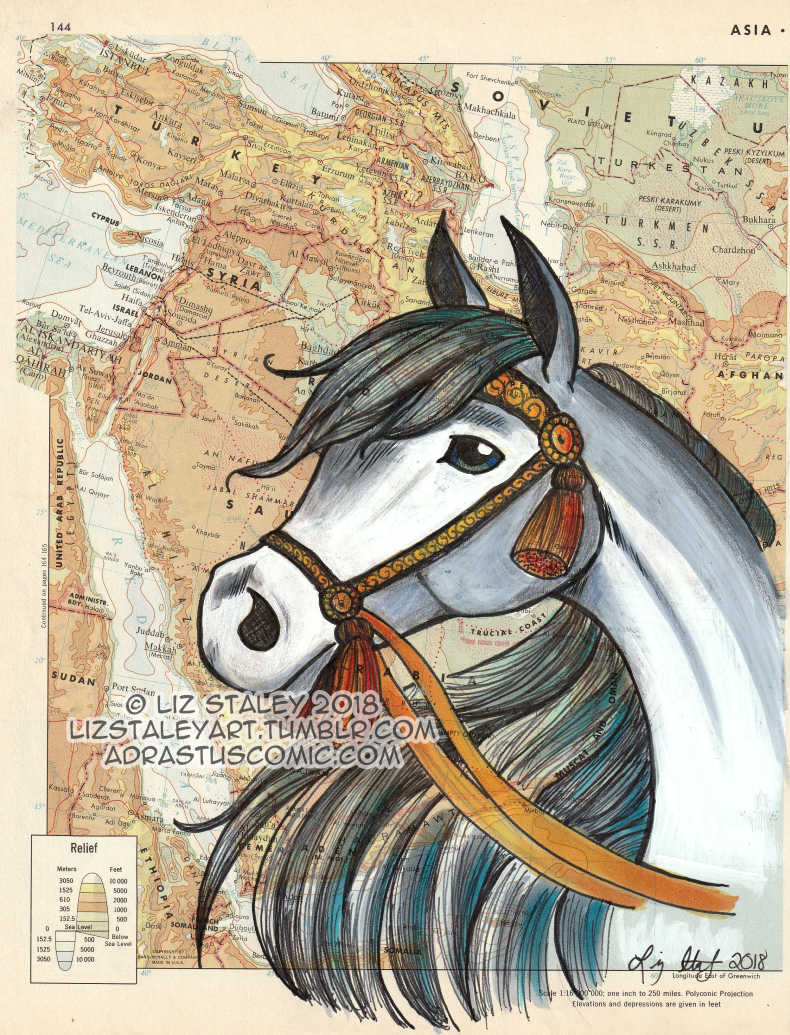
Breed Spotlight – Arabian

Become a Patron!

 The Arabian horse is one of the oldest horse breeds in the world. Archaeological evidence of horses resembling the Arabian have been found in the Middle East dating back 4,500 years. It is one of the most easily recognizable horses in the world. Throughout history, the Arabian has spread around the world thanks to both war and trade. The breed has been used to improve other horse breeds by adding speed, endurance, and strong bone. The Arabian horse bloodline is found in almost every modern breed of riding horse. 

The nomadic Bedouin people of the area where the Arabian developed prized the horses so much that they would often bring them inside the family tent for shelter and to protect the horses from theft. Arabian horses are quick learners, good-natured, and eager to please, with the high spirit and alertness required for war. Arabian horses are the masters of endurance, dominating the sport of endurance riding because of their soundness, strength, and superior stamina. Romantic myths are often told of the Arabian breed, giving them nearly divine characteristics and powers.

There are several myths of the origin of the Arabian horse. One origin myth tells of how Muhammed gave his mares a test of their loyalty and courage by turning them loose after a long journey through the desert and let them race toward an oasis for a desperately needed drink of water. Before the herd reached the oasis, Muhammed called the herd back to him. Only five mares returned to their master, becoming his favorites and being named Al Khamsa– “The Five”. These mares became the legendary foundation mares of the five strains of Arabian horses. 

Another version says that Solomon gave a stallion to the Banu Azd people when they came to pay tribute to him. It was said that every hunt with this stallion was successful, and when he was put to stud he founded the Arabian breed. Several other origin myths claim that the Arabian was created from the wind and stormclouds, including one where Allah says to the South Wind, “I want to make a creature of you. Condense.” The material condensed from the South Wind became the horse.


Assyrian horses on the so called Lachisch relief, from daughterofthewind.org

Arabians are one of the oldest human-developed breeds in the world. Horses with characteristics similar to the modern Arabian have been depicted in rock paintings and inscriptions in the Arabian Peninsula dating back 3,500 years. Ancient Egyptian art as far back as the 16th Century B.C. depicted horses with refined heads and tails with a high carriage. Horses with similar characteristics to the Arabian include the Marwari horse of India, the Barb of North Africa, and the Akhal-Teke of Turkmenistan. 

The desert climate and culture greatly influenced the development of the Arabian breed. The desert environment needed a domesticated horse who would cooperate with humans to survive. Humans were the only source of food and water in some areas. Even hardy Arabian horses require more water than camels in order to live. If there was no water or pasture, the Bedouin would feed their horses camel’s milk and dates. A desert horse needs the ability to survive with little food, and must have anatomical traits that would compensate for the dry climate and extreme shifts of temperature between day and night. Arabians were bred to be war horses with speed, intelligence, and endurance. Mares were often preferred over stallions for raids requiring stealth, because they were quieter and less likely to give away the position of the raiding party. Because the prized horses were often brought inside the family tents at night to protect them from the weather, theft, and predators, a good disposition was necessary. Appearance was not required for the breed’s survival, but the Bedouin bred for refinement and beauty in their horses’ features as well as for their more practical traits.  The Bedouin people knew the pedigrees of their best war mares in detail, including their accomplishments and victories, down through the maternal lines.

There is a misconception that because the Arabian is a small, refined breed of horse, that they are not strong. The Arabian has more dense bone than other breeds, short cannon bones, sound hooves, and a short, broad back, all of which give the horse a physical strength comparable to larger horses. Even a small Arabian can carry a heavier rider. In areas such as farm work, where a heavier horse is an advantage, the Arabian is not suitable because of their lighter weight and smaller stature. For most purposes, the Arabian is a strong and hardy light horse with the capability of carrying any type of rider in most equestrian sports. 

Arabian horse in “Traditional” garb, 2006 Arabian Horse Nationals

Arabians are one of the few breeds where the United States Equestrian Federation rules allow children to show stallions in nearly all show ring classes. This is because of the Arabian’s naturally good disposition. For centuries, only horses with a good nature were allowed to reproduce, resulting in a breed with an overall good and willing disposition. Though the Arabian is considered a “hot-blooded” horse, unlike other high spirited breeds their intelligence enables quick learning and greater communication with their riders. The downside of this is that it is just as easy for the Arabian to learn bad habits as it is good ones, and they do not tolerate inept handlers or abusive training practices. Most Arabians are naturally inclined to cooperate with humans. When treated badly, however, they can become as nervous and anxious as any other horse, but they seldom become vicious unless severely abused. 

The earliest horses with Arabian bloodlines to come to Europe probably did so indirectly, through Spain and France. Other Arabians arrived as spoils of war with knights returning from the Crusades. As heavily armored knights and their heavy war horses became obsolete, the Arabian horses and their descendants were used to develop faster and more agile light cavalry horses. Arabian horses also came to Europe when the Ottoman Turks sent 300,000 horsemen into Hungary in 1522, many of whom were riding pure-blooded Arabians. The Ottomans reached Vienna before they were stopped by the Polish and Hungarian armies. The horses were captured from the defeated Ottoman cavalry, and some of these animals provided foundation bloodstock for the major studs of eastern Europe. 

As the use of light cavalry in warfare began to rise, the stamina and agility of Arabian horses gave an advantage to any army that had them. European monarchs began to support large breeding programs that crossed local stock with Arabian horses. European horse breeders also began to acquire Arabians through direct trade with the desert. By the late 1800’s, the Arabian as a pure breed of horse was under threat due to modern warfare, inbreeding, importing to Europe, and other problems that were reducing the horse population in the Bedouin tribes. Some Europeans began to collect the finest Arabian horses they could find in order to preserve the blood of the desert horse for future generations. The most famous collector of Arabians for the future was Lady Anne Blunt, the daughter of Ada Lovelace and granddaughter of Lord Byron. 
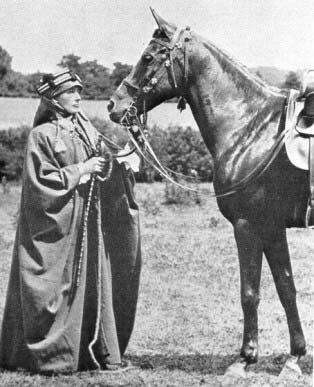
Lady Anne Blunt and the horse Kasida

World War I, the Russian Revolution, and the collapse of the Ottoman Empire destroyed many historic European stud farms. The Spanish Civil War and World War II also had a devastating impact on horse breeding throughout Europe. Many studs, and most records of breeding, were entirely lost. The Soviet Union and the United States obtained valuable Arabian horses as spoils of war. The Soviets had taken steps to protect their breeding stock, and using horses captured from Poland they were able to re-establish their breeding program soon after the end of World War II. Horses captured in Europe were brought to the United States, mostly to the Pomona U.S. Army Remount Station in California. 

In America, the earliest Arabian horses arrived with Hernan Cortes in 1519. More horses followed with each Conquistador, missionary, and settler. Many horses escaped or were stolen and became the foundation stock for the American Mustang. Colonists from England brought horses of Arabian breeding to the Eastern Seaboard. One of George Washington’s horses during the American Revolutionary War was a gray half-Arabian named Blueskin. Other presidents also owned Arabian horses, including President Ulysses S. Grant, who obtained an Arabian stallion named Leopard and a Barb as gifts from the Sultan of Turkey. 

George Washington on his half-Arabian, “Blueskin”

One of the earliest American breeders of Arabian horses was A. Keene Richard. He crossed his Arabians with Thoroughbreds, but also bred pure Arabian horses. Unfortunately, his horses were lost during the Civil War and have no known purebred Arabian descendants today. Leopard is the only known stallion imported before 1888 who has known purebred descendants in America. 

In 1908, the Arabian Horse Registry of America was established and recorded 71 animals. By 1994, the number of animals registered was half a million. There are more Arabian horses registered in North America today than in the rest of the world combined. 

In the 1980’s, the Arabian horse became a popular status symbol. The horses were marketed in a similar fashion as fine art. Prices for Arabians went through the roof, with some people using the horses as tax shelters. A record-setting auction had a mare sell for 2.55 million dollars in 1984. A stallion sold at the same auction for 11 million dollars. The potential for profit on the horses led to over-breeding, and when the tax law was changed in 1986, the Arabian market was particularly vulnerable to over-saturation and inflated prices. The market soon collapsed, forcing many breeders into bankruptcy. Many pure-bred Arabians were sent to slaughter in the aftermath. The prices for Arabians recovered slowly after many breeders moved away from creating “living art” and began producing horses suited toward amateur owners and a variety of riding disciplines. As of 2013, there are more than 660,000 registered Arabians in the United States, the largest number of Arabians in any nation in the world. The second largest registry in the world is the Australian Arabian Horse Registry.

The genetic strength of the desert-bred Arabian horse has led to the bloodlines having a hand in the development of almost every modern light horse breed. This includes the Thoroughbred, Orlov Trotter, Morgan, American Saddlebred, Quarter Horse, Trakehner, Welsh Pony, Australian Stock Horse, Percheron, Appaloosa, and the Colorado Ranger Horse. Arabians are crossed with other breeds to add refinement, agility, beauty, and endurance. Some half-Arabian crosses, such as the Morab (Morgan-Arabian) are even popular enough to have their own breed registries. 

There is some debate over the role the Arabian played in the development of other light horse breeds. DNA studies of multiple horse breeds suggest that, after the domestication of the horse, the location of the Middle East as the crossroads of the ancient world allowed the Oriental horse to spread through Europe and Asia. There is little doubt that humans crossed “oriental” blood to create other breeds of light riding horses. The only questions are at what point the “oriental” type horse could be called an “Arabian”, how much Arabian blood was mixed with local animals, and at what point in history. For some breeds of horse, such as the Thoroughbred, Arabian influence is documented in written stud books. For older breeds, the date of Arabian influx of breeding is more difficult to determine. 

Arabians are intelligent, willing, and versatile horses that compete today in many equestrian disciplines. Horse racing, saddle seat, Western pleasure, hunt seat, dressage, show jumping, cutting, reining, endurance riding, eventing, and youth events all see Arabian participants. They are used for pleasure riding, trail riding, and working horses. The Arabian dominates the sport of Endurance riding thanks to their superior stamina. They are the leading breeds in competitions such as the Tevis Cup, where they can cover up to 100 miles in a day. 
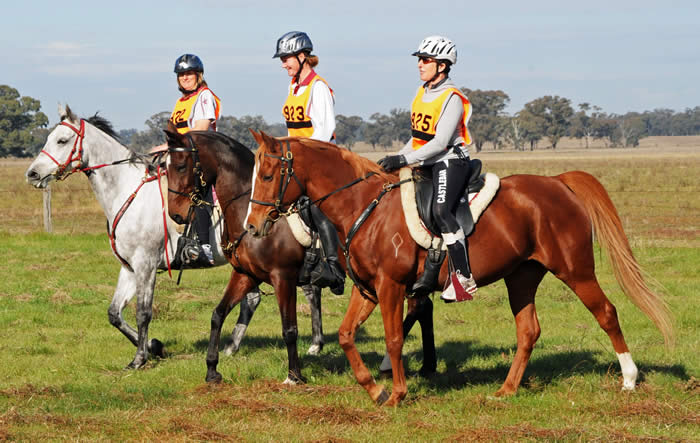
Anglo-Arabian Endurance Competitors

Series of horse shows specifically for Arabians and half-Arabians exist in America, Canada, Great Britain, France, Spain, Poland, and the United Arab Emirates. In North America, the Arabian Horse Association’s “sport horse” events draw up to 2000 entries. This competition sees Arabian and part-Arabian horses performing in hunter, jumper, dressage, combined driving, and sport horse under saddle and in hand classes. 

Purebred Arabians have also excelled in open events against other breeds. They have won against other breeds in Refined Cow Horse, cutting horse, show jumping, and show hunter competitions. A purebred Arabian competed on the Brazilian eventing team in the 2004 Athens Olympics. Arabians have won Olympic medals in dressage and show jumping as well. 

Arabians have been popular in movies dating back to the silent film era when Rudolph Valentino rode the Arabian stallion Jadaan in 1926’s “Son of the Sheik”. They have been seen in many films, including The Black Stallion, as well as Hidalgo and Ben-Hur. They are popular mascots for sports teams. Arabians are also used in search and rescue teams and for police work, as polo horses, in circuses, therapeutic horse riding programs, and on guest ranches.

The Arabian is a breed that has had influence all over the world. From the tents of the Bedouin people who fed their prized mares dates and camel’s milk, to the personal mounts of kings and Presidents, to the Olympic games. They are truly a versatile breed with intelligence and a willing disposition. 

Find out more about the Arabian breed at the Arabian Horse Association’s website at https://www.arabianhorses.org/

Become a Patron!
Posted on Leave a comment

Breed Spotlight – Nokota Horse

Become a Patron!

By the early 20th century, the feral and semi-feral horse known as the Nokota was nearly wiped out by ranchers and state and federal agencies in North Dakota. When Theodore Roosevelt National Park was created in the 1940’s, a few bands of Nokota were inadvertently trapped inside by workers, and were thus preserved. 

The Nokota horse developed in the 19th century in the southwestern corner of North Dakota, in an area known as the Little Missouri River Badlands. Horses from domestic herds mingled with the original feral herds. Ranchers often crossbred Spanish horses from the southwest, local Native American ponies, and various draft, harness, Thoroughbred, and stock horses to create hardy and useful ranch horses. The Nokota horse has an angular frame and prominent withers, usually standing between 14.2 to 17 hands. They often exhibit an ambling gait called the “Indian Shuffle”. They are often blue roan in color, which is rare in other breeds. Black and gray are also common colorations for the Nokota. Less common colors include red roan, bay, chestnut, dun, grullo, and palomino. Pinto patterns occur on occasion. 

Nokota horses today are used in many horseback riding events, including endurance riding, western riding, fox hunting, dressage, three-day eventing, and show jumping. The breed is described by fans as “versatile and intelligent.”

There are two commonly cited sources for the Nokota name. One source states that the Nokota gets its name from the Nakota people who inhabited North and South Dakota. The other origin claims the name comes from a combination of North and Dakota, and was created by the Kuntz brothers.

In 1884, a ranch near Medora, North Dakota, called the HT Ranch purchased 60 mares from a herd of 250 Native American-bred horses that were originally confiscated from the Lakota leader Sitting Bull in 1881. Some of the mares were bred to the Thoroughbred racing stallion Lexington, also owned by the ranch. 

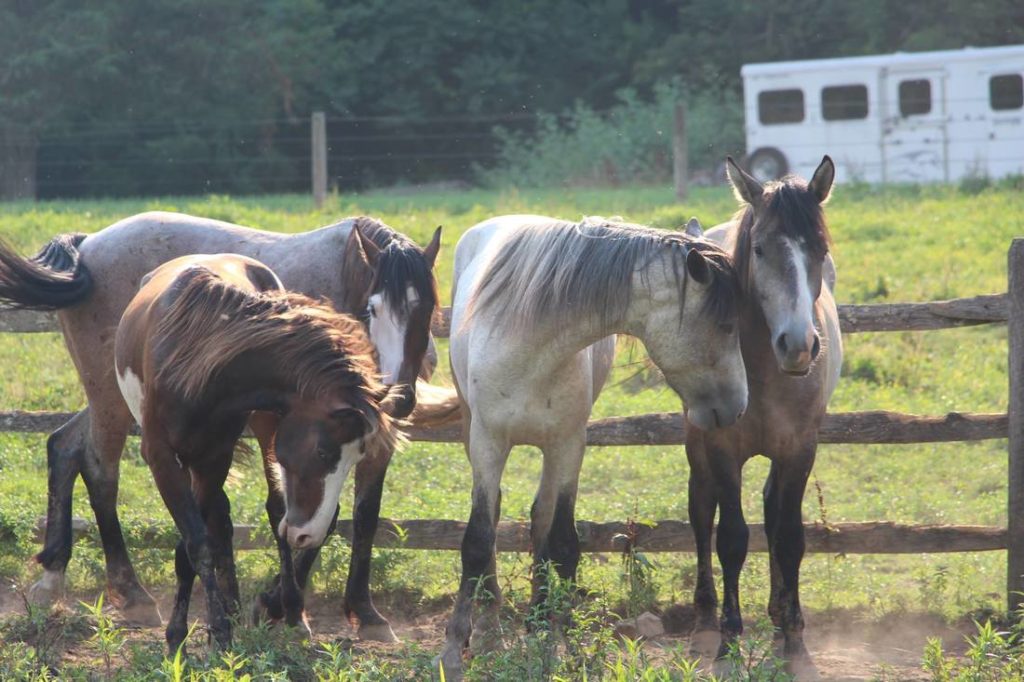
Nokota Horses: Photo from the Nokota Horse Conservancy

By the early 20th century, the feral herds became the target of local ranchers who wanted to limit grazing competition for their own herds. Many horses were removed from the wild, used either for ranch horses, sold to slaughter, or killed. From the 1930’s to the 1950’s, federal and state agencies worked with the ranchers to remove the horses from western North Dakota. The species was all but extinct by the time that Theodore Roosevelt National Park was established in the 1940’s. During construction, a few bands of the horses were accidentally trapped in the park when the fence was constructed. By the 1960’s, these bands of horses were the last remaining feral Nokota in North Dakota. 

Despite their status, the park sought to eliminate these feral bands of horses. The National Park Service was declared exempt from the Wild and Free Roaming Horses and Burros Act of 1971, an act that protected free-roaming horses and burros on other federal lands. This allowed the park to view the Nokota horses as a nuisance and deal with them as such, which included sending many of them to slaughter. In the 1970’s, public opposition to the removal of the feral horses prompted management strategy changes. Today, the herds within the Theodore Roosevelt National Park are managed for historical demonstration purposes. 

In 1986, the park added outside bloodlines into the feral bands with the aim of modifying the appearance of the Nokota because management of the park felt the resulting horses would sell better at auctions. Dominant herd stallions were removed and replaced with a crossbred Shire stallion, a Quarter Horse stallion, an Arabian stallion, and two feral stallions from the Bureau of Land Management Mustang herds. At the same time, a large number of horses from the park were rounded up and sold. At this auction, Leo and Frank Kuntz purchased 54 horses, including the dominant stallion, because they were concerned about the welfare of the Nokota horses. 

By 1993, the Kuntz brothers had a herd of 150 Nokota horses, including those purchased from the park over the course of several auctions and the descendants of those horses. The horses were mainly used for ranching and endurance races. In that year, the Nokota was declared the Honorary State Equine of North Dakota. In 1994 , researchers conducted a study of the horses in the park and on the Kuntz ranch. They discovered that none of the horses in the park and only about 20 on the ranch had characteristics consistent with the Colonial Spanish Horse. Since that study, the horses on the Kuntz ranch have been bred with the goal of maintaining and improving their Spanish characteristics. In 1999, the Kuntz brothers founded the Nokota Horse Conservancy to protect and conserve the Nokota horse. The Conservancy tracks around 1,000 horses throughout the United States. 

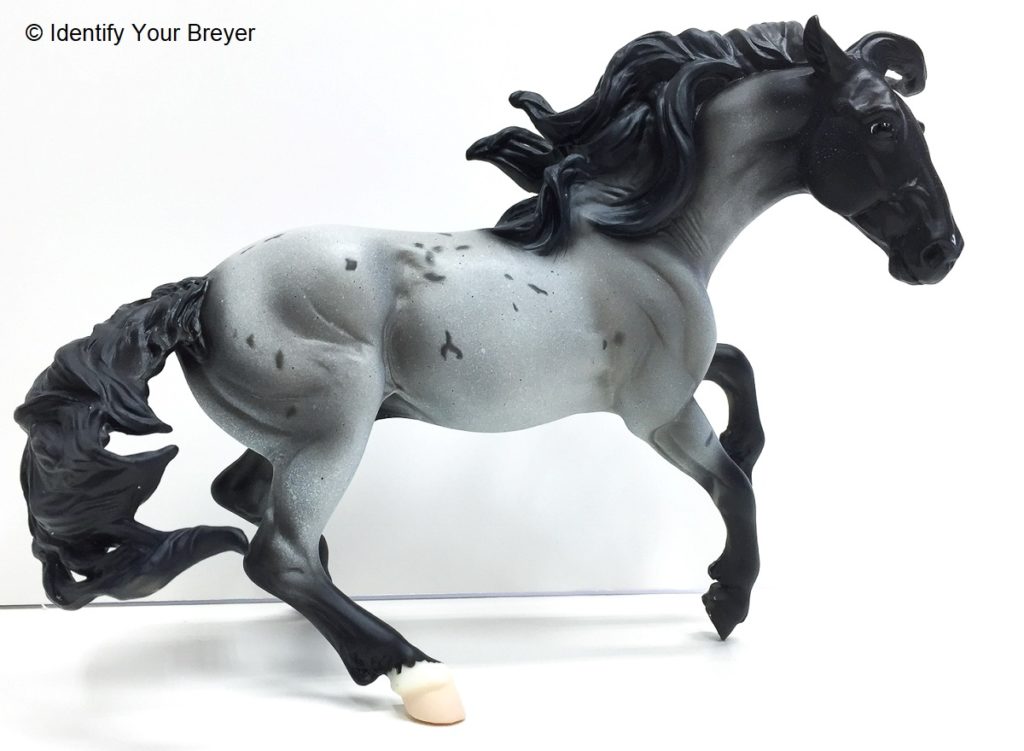
Breyer Nokota Horse Model

In recent years, Theodore Roosevelt park has continued to thin the feral Nokota herd. Several round-ups were conducted throughout the 1990’s and the early 21st century. In the year 2000, the last horses to be considered of the “traditional” Nokota type were removed from the wild. Some were purchased by supporters of the Nokota Horse Conservancy. The National Park Service maintains a herd of 70 to 110 horses.

The Breyer Animal Creations annual “Benefit Horse” Campaign chose to honor the Nokota in 2006. A Breyer model was created, manufactured, and marketed throughout the following year, with a portion of the proceeds going to the Nokota Horse Conservancy. In 2006, the Kuntz family owned approximately 500 Nokota, with the Conservancy owning another 40. At that point, there were less than 1,000 living horses of the breed in the world. 

In the fall of 2009, the North Dakota Badlands Horse Registry was created to register horses that have been removed from the park. They state that these horses are not accepted by the main Nokota Horse Registry. In March of 2011, approximately 40 horses had been registered to this organization. The Nokota Horse Registry is run by the Nokota Horse Conservancy, and currently has around 2,000 horses in the registry. 

Learn more about the Nokota Horse by visiting https://www.nokotahorse.org/ 

Become a Patron!
Posted on Leave a comment

Breed Spotlight: Australian Brumby

Become a Patron!

 Recently, I completed a new horse breed design of the Brumby horse. 

A Brumby is a free-roaming wild horse in Australia. They are mostly found in the Australian Alps region and the Northern Territory, with the second largest population in Queensland. 

The first recorded use of the term “Brumby” in print was in 1871, and had the connotation of an inferior or worthless animal. Several other origins of the term have also been cited, including the Once A Month magazine suggesting that it came from a South Wales term, “rumbies”. The poet Banjo Paterson stated in the introduction of his poem “Brumby’s Run” that the word is of an Aboriginal origin and means “Wild Horse”. It’s derivation is obscure, and may have come from a number of different sources. This includes being named after Sergeant James Brumby, an Aboriginal word “baroomby” which means wild, and the name of the Baramba creek and station in the Queensland district of Burnett. 

Brumbies are the descendants of escaped or lost horses that in some cases date back to those belonging to the early European settlers, including the “Capers” from South Africa. Timor ponies from Indonesia, British ponies and draft breeds, and Thoroughbreds and Arabians have likely made up a large amount of the Brumby breed. Horses first arrived in Australia in 1788. They were imported for utility and farm work, for recreational riding, and for racing. Only 200 horses had made their way to Australia by the year 1800. An influx in Thoroughbreds came when horse racing became popular around 1810. By 1820, roughly 3500 horses were living in Australia. This number had increased to 160,000 horses in just thirty years. Because of the long journey by sea from England, Europ, and Asia, only the strongest and heartiest horses could survive. This made for a healthy and strong Australian stock and contributed to their ability to flourish. 

The first report of an escaped horse was in 1804. By the 1840’s, some horses had escaped from the settled regions of the country. Some likely escaped from improperly installed and repaired fences. But it is believed that many of the feral horses came from horses released into the wild and left to fend for themselves when pastoralists abandoned their settlements. After World War I, the number of unwanted animals who were set free increased due to a decreased demand for horses and an increase in mechanization. Throughout the 20th century, demand was further decreased thanks to the replacement of horses in farming with machines like tractors. This likely increased the population of wild bands of horses even more. 

Currently, there are around 400,000 horses roaming the continent of Australia. It is estimated that in non-drought conditions the population increases by 20% each year. Drought conditions and brushfires are natural threats to the horses. Despite their high population numbers, the Brumby horse is considered a moderate pest. The impact on the environment can be detrimental in areas where the horses are allowed to damage vegetation and cause erosion. Because the horses also have cultural and economic value, the management of the Brumby bands is a complex issue. 

Today, the Brumby bands live in many places, including some National Parks, such as Alpine National Park in Victoria, Barrington National Park in NSW, and Carnarvon National Park in Queensland. Occasionally they are rounded up and domesticated for use as stock horses, trail horses, show horses, Pony Club mounts, and pleasure horses. 

The Brumby horse is at the center of some controversy. Some people regard them as a pest or threat to native ecosystems. Others value them as part of Australia’s heritage. Supporters work to prevent inhumane treatment and extermination of the Brumby, and also rehome horses who have been captured. Wild Brumbies are used in Brumby training camps by organisations that promote positive interaction between troubled, high-risk youths. These camps usually last several weeks, allowing youths to train a wild Brumby to become a quiet, willing saddle horse while improving the youths’ self-esteem.

You can help these horses at https://www.savethebrumbies.org/ 
Become a Patron!
Posted on Leave a comment

10 Valentine’s Gift Ideas for Equestrians

 If you have an equestrian in your life, you might be wondering what to get them for Valentine’s Day! Equestrians can be hard to shop for, because it seems that some of them have everything (and, more frustratingly, some of them need everything to be JUST THE RIGHT SHADE of their riding color!) but hopefully this list can give you an idea or two for the horsey person you love.

Note that this article has affiliate links that help support this blog. Clicking one of the links below and purchasing an item will give me a small percentage of the sale.

1. Fashion Scarf (with horse design, of course!)  Any equestrian will appreciate something warm to wear since our sport puts us outside in the cold a good bit of the time. But how about a nice scarf to wear while we’re not at the barn? So many of my clothes are “barn clothes” that I feel like I have nothing to wear when I want to dress up a bit, and I’m sure other equestrians feel the same way sometimes! This lovely fashion scarf has a delicate and subtle horse pattern in colors that would be easy to match to any outfit.


2. Hand-painted wooden memory box  A memory box can be small enough for some tail hair and a few other tiny mementos, or large enough to put a halter, show ribbons, and horseshoes inside. This hand-painted memory box is made of willow and crafted by artist Susan Lordi. It includes a lovely sentiment on the inside and is big enough for a tail hair bracelet and a few other small items, such as jewelry or bridle charms. Would be a beautiful way to store jewelry and baubles or to fill with keepsakes of a cherished equine friend!


3. Sterling Silver Horseshoe Pendant with Rose Gold Heart Jewelry is almost always a good Valentine’s Day gift, and this lovely sterling silver pendant is beautiful and horse themed! Rose Gold has become very popular in equestrian items in the past few years, and this pendant includes a little rose gold heart at the top of the horseshoe, making it a great way to show your love for the horse lover in your life. 


4. Swedish Chocolate Horses filled with assorted Truffle flavors Chocolate is a favorite for Valentine’s day, and these little Swedish candies are shaped like horses. They come in various types and flavors, but the ones in the link are various truffle fillings. Yum! 


5. Gift Horses Soy Candles With scents like “In the Tack Room” and “Rescues Love Peppermints”, these candles will remind the horse lover of the barn, no matter where they’re at! These candles are made in the U.S.A. and are high-quality soy wax. They are eco-friendly and non-toxic.


6. Horse Wine Bottle Holder I’m not a drinker, but I know a bunch of my fellow horseback riders are, so this one is for them! This fun and dynamic horse sculpture doubles as a wine bottle holder and is a definite conversation starter. Pair it with a bottle of your equestrian’s favorite wine for a whole package gift! 


7. Love Horses Bracelet These cute bracelets are fashionable and they very blatantly say that the wearer loves horses. They come in a few different colors, so hopefully, you’ll be able to match your equestrians riding outfit color! OR just get black. You probably can’t go wrong with black!


8. Hold Your Horses Book This book is full of humorous nuggets of wisdom that will touch the hearts of everyone, young and old, who loves horses! The author, Bonnie Timmons, is an award-winning illustrator who loves horses (and that makes me love her instantly!)


9. Horse Coloring Book Owning, riding, and working with horses can be really stressful. Coloring is a great way to deal with stress! And this coloring book has 40 horses to color, so you can de-stress from your horsey life by looking at drawings of horses. What could be better? 


10. Horse Notecards Equestrians need to write notes to the barn manager, to their trainer, to the hay guy, and to the farrier. These notecards, drawn and sold by me, are perfect for any correspondence- not just ones related to your hooved best friend. With these cards, the equestrian in your life can send their letters in style! Comes in a set of 12 or 8, complete with envelopes.
I hope this list gave you some ideas for a great gift for the horse lover in your life. Share what you’re getting your equestrian in the comments! 

Posted on Leave a comment

Learn Clip Studio Paint now available!

 Some of you who only know me through my horse drawings may not know that I am also a writer. I love to write fiction, but in the past few years I have also written several software books for the digital art software “Clip Studio Paint” (formerly known as Manga Studio 5). 

Through the latter part of 2018, I worked on the 2nd Edition of “Learn Clip Studio Paint“, published by Packt Publishing. I’m very pleased to say that this book was released in late December and is now out! I got my advance copies a few days ago and am so pleased with how they turned out. 

Clip Studio Paint is a world-class art software used by over four million creators worldwide to create comics, manga, illustrations, concept art, and more. Unlike most other art software, Clip Studio Paint is created with artists in mind- most specifically comic artists. It has a powerful and highly customizable brush engine, allowing the user to achieve a variety of real-world media looks like watercolor and oil paint in the digital realm. It also includes digital rulers, speech balloon tools, perspective tools to assist in drawing backgrounds, 3D models that can be posed and edited, materials like patterns, images, and screentones, and more. 

Learn Clip Studio Paint 2nd Edition is the updated version of “Manga Studio 5 for Beginners”, written by Michael Rhodes. After Michael couldn’t complete the update because of personal reasons, I was asked to take over writing the book. It was an honor to work on and publish my third software book with Packt Publishing! 

Through the course of this book, the reader learns how to select a computer to run CSP, as well as the differences between CSP Pro and CSP EX. They learn how to install the software and navigate the interface, as well as how to create new files. Customizing tools like brushes and other drawing tools are covered, as well as the basics of inking your work. This book is ideal for beginner’s and those switching from other graphic software programs. 

As of the time of this writing, the e-book version of Learn Clip Studio Paint is on sale for just $5, so snatch it up quick before the sale ends!

Posted on Leave a comment

Fear of Stirrups: How I Conquered My Anxiety and Got in the Saddle

I have anxiety. 

I was officially diagnosed with it about two years ago and started taking medication, but looking back on my life, I’m pretty sure I’ve always been extremely anxious. As a child, I remember reading a science book and then being terrified that the sun was going to blow up and we were all going to burn up and die. I was scared during fireworks displays on the Fourth of July that bits of smoldering fireworks were going to drop on my head and burn me. School turned me into a wreck if we had to answer questions in class or read out loud because I was terrified I would mess up and make myself look like an idiot in front of my classmates.

Yeah, I’m pretty sure I’ve had anxiety my entire life and no one really noticed. I was a crybaby, and anti-social, and a scaredy-cat, and any other manner of mean name you could call a child who has anxiety and no one is willing to open their eyes to that fact. 

As a child, I always wanted to have a horse and learn how to ride. That dream didn’t start coming true until I turned 30, and suddenly I had the opportunity to work with horses and learn how to ride. Learning to ride at 30 years old is not easy, let me tell you. First of all, most people at that age know very well that they can die at any moment, thank-you-very-much, and so I didn’t have the luxury of learning during that fearless time that young children have. Though sometimes I wonder if, because I have had anxiety since a very young age, I ever had that “fearless and immortal” period of my life at all. 

“Even with medication, all these falls started making me anxious.”

Anxiety on Four Hooves

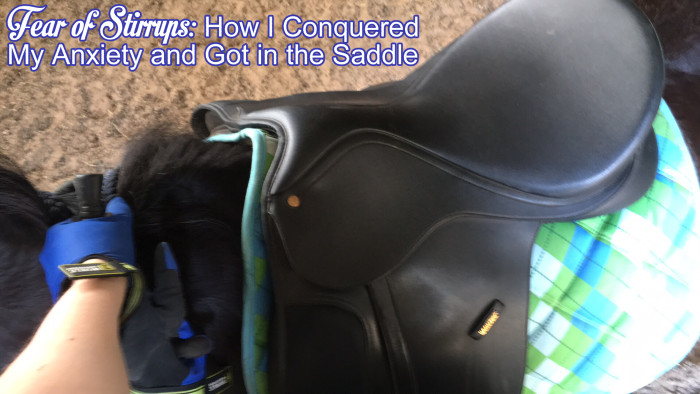
One of the first times I ever got in a saddle without someone else checking the girth (the strap that holds the saddle to the horse) for me, the horse walked away from the mounting block while I was just starting to get on, the saddle slipped, and I fell under the horse. During a riding lesson at another barn, I went to get on a lesson horse who wouldn’t stand still at the mounting block at all and I ended up going right over the other side and falling. Before I had another couple of falls in the past year and a half of riding, ninety-percent of my horseback riding related falls were while I was trying to get in the saddle.

Even with medication, all these falls started making me anxious. Since they happened mostly when I was getting on the horse, I began to get seriously terrified of not having my girth tightened enough that my saddle wouldn’t slip when I got on. Getting in the saddle when there was no one there to hold my horse was also a nightmare, because what if I tried to get on and they walked off without me firmly sitting down in the saddle?! The horror!

It got to the point where I would double and triple check my girth before getting on the mounting block. Then I would play a game called “The mounting block isn’t the correct distance from the horse”, and I would go down and up the mounting block several times, adjusting its position until it was perfect. Then I would stand on the top of the mounting block, staring at my saddle as though it were a firing squad. Eventually, I might get in the saddle, or I might just call it quits and decide not to ride at all. 

We got a VERY tall mounting block eventually at the barn I boarded at, and that made things a little bit easier. I could put my horse (a rather short Morgan mare) next to it and literally swing my leg over and sit down, no stirrups required. And since there were no stirrups required to get on, I could be reasonably sure that my saddle wouldn’t slide and deposit me on the ground underneath an animal with four hard hooves and that spooks easily. 

But this didn’t really solve my anxiety. And things just became worse when the person who owned that mounting block left, taking my salvation with them. 
I got a breastplate, figuring that even if it wasn’t actually designed to stop a saddle from rolling side-to-side, it would be enough of a placebo effect that I would be able to calm my anxiety and get on. But even with the extra piece of tack to give me peace of mind, the anxiety was still there. 

“Yes, anxiety about being anxious! I truly am a mess!”

I soon realized that the anxiety was stemming not just from fear of the saddle slipping, but also from the fear of the horse walking away before I could get in the saddle, AND from my embarrassment about my anxiety. Yes, anxiety about being anxious! I truly am a mess! I knew that I was going to have to get over this and get on my horse like a normal human equestrian is supposed to, not climbing down onto the horse’s back like I was doing a squat in the gym. (Besides, the taller mounting block only allowed me to do that if the horse was as short as my personal horse, and not many of them are. If I rode a taller horse, I was out of luck and HAD to use the stirrup to get on!)

I was in a bind. Nothing I’d tried had worked yet, but I was determined that I was going to stop having so much anxiety about an activity that I truly love and I was going to teach myself to get over this and stop being stared at while I climbed into the saddle like it was my first day of riding. By now I had been riding for almost five years and this just seemed silly. But I was lost on how to make myself not anxious when even buying a piece of tack that was supposed to help me didn’t help at all. 

The answer came to me one day when I was going through TED Talk videos on YouTube. I’ve been in a huge “personal development” phase this year and I randomly stumbled across an interview with Mel Robbins conducted by Tom Bilyeu on how to stop procrastinating and stop being anxious. I watched the interview, enthralled with the simplicity of this technique. And it really, really is very simple. If you don’t have time to watch the interview or don’t know about Mel Robbins’ “Five Second Rule”, let me sum it up.

In the Five Second Rule, you give yourself a task that you need to start. Let’s use getting out of bed since it’s her example in the video. So you say to yourself, “I am getting out of this bed now,” and then you count backward from five to one, and you start that task. It helps squash procrastination because you have a set time limit to start the task, and it kills anxiety because five seconds isn’t enough time to second guess your decision. A simple “5-4-3-2-1” seemed… TOO simple. 

But it was worth a shot when everything else had failed me, right?

I was eager to try this technique and was going riding with some friends the next day. I told myself that I was going to make sure my girth was tight, then I was going to do my countdown and get in my saddle- and I was going to use my stirrup to do it like a normal equestrian! 

“5 – 4 – 3 – 2 – 1!”

The next day came and I repeated my plan over and over again to myself as I tacked up. I made sure my girth was good and snug and that my helmet was on, and I went to the mounting block. I made sure to adjust the mounting block back a little further than normal so I would have room to use my stirrup. Then I got to the top step, adjusted my reins, put my foot in the stirrup, and said “Five, four, three, two, one!” 

Boom! I was in my saddle! I was giddy over this little victory, could my stirrup worries be over with, finally? I had to get down at one point during that ride to adjust something in the arena, and I used my countdown to get on using my stirrups again. Two for two, I was on fire! Then my friend asked if I wanted to ride her horse for a few minutes because I had never been on him before. This horse is significantly taller than mine, and I knew I was going to have no choice but to use the stirrup for this one. Another countdown and BAM! I was on a horse that I’d never ridden before, and I’d used a stirrup to get there, and I hadn’t fallen off! I was over the moon!

I am happy to report that I now have very little anxiety while getting in the saddle. I can’t say that it’s completely gone, because I often ride a friend’s horse bareback and that horse walks away from the mounting block like she’s just been kicked in the butt the second you get on her back. But when I’m on my horse I use my stirrup and I don’t get anxious about it. I know now that even if my saddle slips a little, I’m good enough that I can still get on without falling. Those little baby steps and a five-second countdown gave me the confidence I needed to get through the anxiety and start enjoying the beginning of my rides. 

I still have a long way to go with my anxiety, even when I’m riding, but I know that I can get there. And I know that because I conquered my fear of a silly little thing like putting my foot in a stirrup. 

Have you ever had an anxious reaction to something that you knew was silly, and if so how did you deal with that anxiety? Have you ever used the five-second rule to deal with your anxiety? I’d love to hear your stories in the comments or on Facebook! Or you can email me to connect too.


Posted on Leave a comment

Marwari Horse Process Video

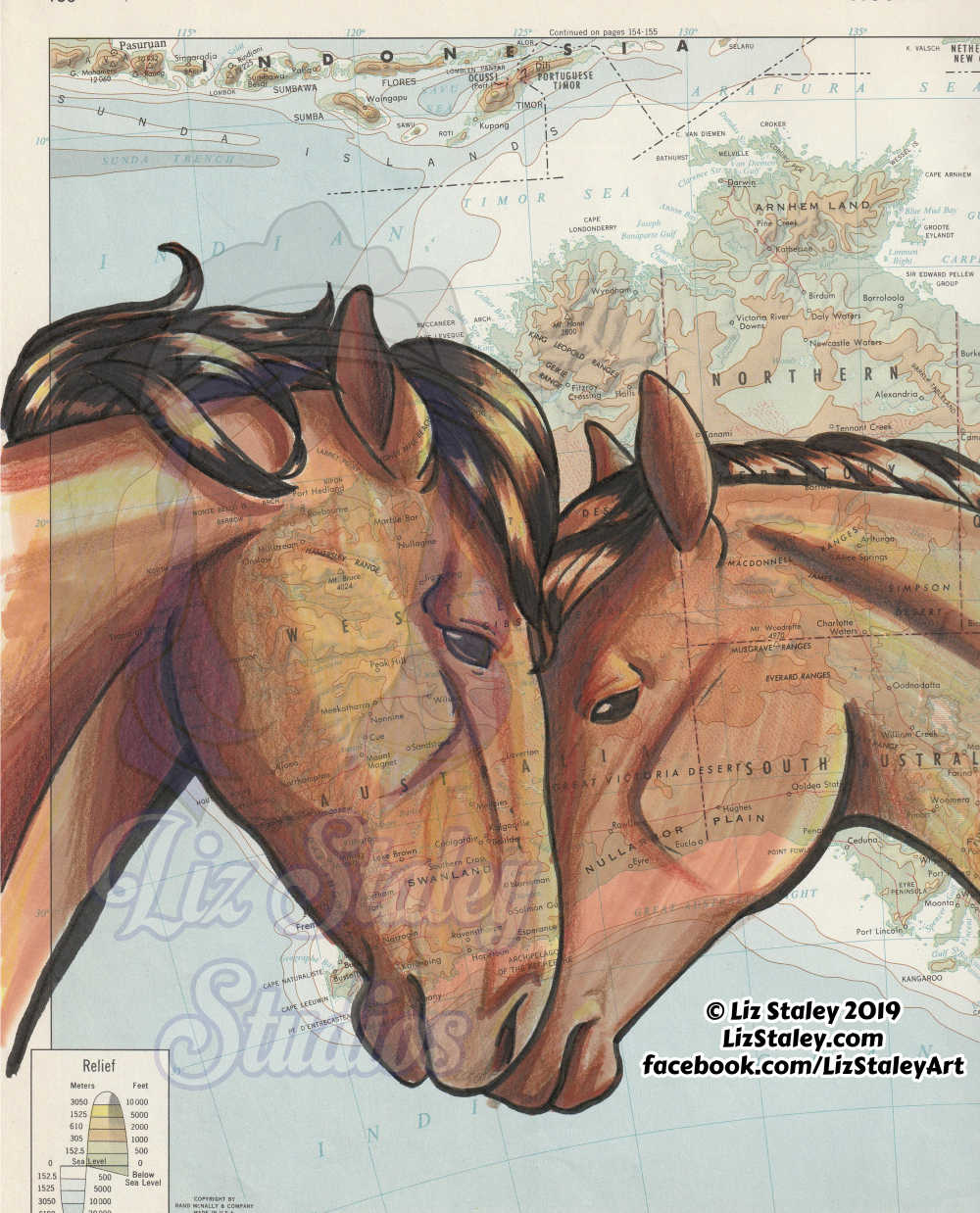
Video of me working on the Marwari Horse drawing. In this video I use a lightpadto trace the sketch onto the map page with Copic Multiliner pens. Then the large areas of base color are added with Copic Markers. I use Fantasia Artist Premium Colored Pencils to add additional shading and highlights over the marker. The real-time on this drawing was about 90 minutes (not including the initial sketching of the horse, which I didn’t film).

Thanks for watching, and don’t forget to check out my other blog post with more information about the Horses of the World series!

Posted on Leave a comment

The Story Behind The Horses Of The World

I’ve gotten a good bit of attention locally for my Horses Of The World series. This series of art is very special to me and is one that I really enjoy working on. As I write this blog post there are 20 completed horse breeds. 

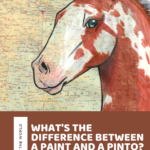
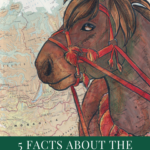
In this series, I use mixed media to attempt to tell the story of horse breeds and where they come from. Each breed of horse is drawn on a vintage map page from a page of the Goode’s World Atlas by Rand McNally (11th Edition, 1960). I pick the map page to draw on based on the area of the world the horse breed originates from- so the Arabian horse, for example, is drawn on the map of Saudi Arabia. I use this as a way to tell a story about the horse breeds that we all love but may not know where they originated from in the world. 

I create these pieces of art by first researching the horse breed I want to illustrate and then checking to make sure I have a corresponding map page. The first eighteen horses in the series were sketched directly onto the map pages, but recently I have started sketching on plain paper and then transferring the sketch to the map via a lightbox instead because sometimes it’s difficult to see the sketch overtop of the map lines, especially on particularly busy maps, and I have a difficult time with the inking process. Once the sketch is complete, the drawing is inked with waterproof and alcohol marker proof Copic Multiliner brush pens. The inked lines are allowed to dry for a while and then the coloring process begins!

Coloring occurs directly on the original map. I use a variety of materials to add the color to the horse drawings. White/gray horses get a light coat of white acrylic paint as a base, usually from a white paint pen. Darker colored horses get large areas filled in with alcohol markers (Copic or Spectrum Noir, I have both kinds). Then additional shading, highlighting, and details are added with colored pencils. Horses who had paint used on them have any lines that were painted over touched back up with the same inking pens as before since the paint tends to wash the ink lines out when it goes over them and I like for the inking lines to be bold and dark! 

This series of drawings is very important to me. I have loved horses ever since I was very young, but I grew up in Baltimore, Maryland and there was nowhere around for a young girl from a middle-class family to do anything with horses. I remember pony rides at various events on occasion, probably especially at the Maryland Renaissance Fair, and one of my cousins had horses on their farm when we were younger so at Easter and Christmas we would sometimes get pony rides there as well. But I never had the opportunity to actually learn to ride, or to have a horse of my own. So instead of being around horses in physical space, I was with them mentally. I read every book on horses at my local library, and read every book with horses in it that I could find at thrift stores or flea markets. Horses were the first subject that I could draw fairly well. I remember having a How To Draw Horses book that I studied almost religiously. I would doodle horse heads on everything. I couldn’t be around horses in real life, so I was with them in my mind and in my art.

Eventually, as I grew older, I gave up on the dream of ever actually being around horses, or owning one, or riding them. But I still would stare at a field of horses as we drove past, or watch horses in movies, or make sure my character had a horse in a role-playing game. All of that changed when I turned 30. I had just quit my day job to make a go at being self-employed, and I was looking for some sort of volunteer opportunity. I had been collecting My Little Pony figures over the past few years and decided that I wanted to find something horse related. I stumbled across a local riding school looking for volunteers to help with their summer camp, and no experience was needed! 

I volunteered and that was the beginning of horse madness. Through all of this, a friend I had who owned a horse realized that I liked horses. Two years later, her horse became my horse. Glory and I have been together for five years now and she is my constant muse and source of stress relief. I wouldn’t trade her for anything!

Posted on Leave a comment

My Recommended Art Books

Often I’m asked what books people can look at to learn more about art and honing their skills. I decided to put together a list of books that have been helpful to me in the past and/or I currently own and refer to often. This is my own personal list of what books I find helpful. These titles may or may not help you in your art journey as well, as all artists are different and learn in different ways. So here are the books that I’ve found helpful in the past!

This list contains Amazon affiliate links. Purchasing items through links in this article gives me a small commission on Amazon (which I will then use to purchase more art books and supplies…)

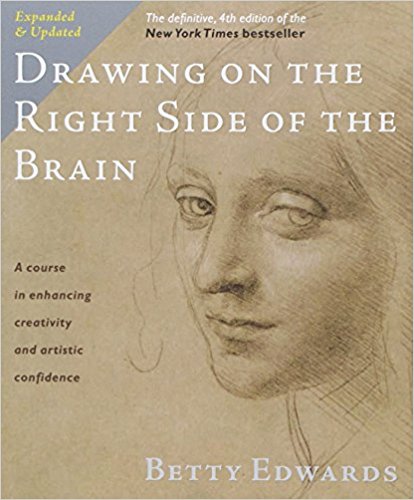
Drawing On The Right Side of the Brain

This is THE book that I recommend to anyone who says to me “I want to learn how to draw but I have no idea how to get started! I can’t even draw a stick figure!”. I used this book a looooong time ago (like… 1998-long-time-ago) but I can’t imagine that it has changed that much over the years. Drawing On The Right Side Of The Brain teaches you how to switch to “Right-Brain Mode” and see the world as an artist. With lots of easy to complete lessons that won’t take complicated or hard to obtain supplies, this book is accessible and a great start for training your brain how to discern basic shapes and start drawing what you actually see. Note that this is not a comic or cartooning drawing book, but a book on drawing from observation, which is absolutely essential no matter what sort of art you want to do!

I used this book back in high school, as I said. At the time I was a decent (for my age) artist with both drawing from life and cartooning. My skills after doing only half of this book saw a drastic improvement, which is why I absolutely recommend this book to anyone who wants to get start with art.

Vanishing Point: Perspective for Comics

Learning perspective is essential for anyone wanting to draw, whether that be drawing comics and cartoons or otherwise. Even drawing the human figure at any angle other than straight-on requires some knowledge of perspective! I got this book for Christmas one year not long ago because I wanted to brush up on my perspective skills for my comic panel backgrounds. Not to sound dramatic, but this perspective book pretty much changed my life. The material is presented in a way that’s easy to understand even for perspective beginners. But there are also tips on advanced perspective drawing that will benefit those who have been drawing in perspective for a long time. I asked for this as a refresher course and got so much more than that, as it taught me tricks for how to make drawing in perspective easier that I had never seen before. The exercises in this book are easy to follow no matter what your level of skill is with perspective.

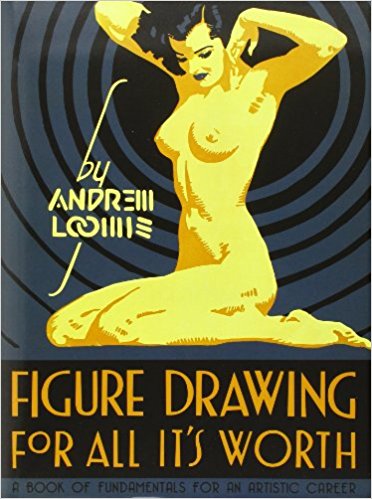
Figure Drawing For All Its Worth

If you want to learn about human anatomy, Andrew Loomis is where it’s at. Not only does this book go over ideal proportions, muscle groups, and features, but it also talks about foreshortening, proportions in perspective, and how to draw the figure in different centers of balance and motion. Not only is Andrew Loomis’ work fantastic to look at, but reading the text is helpful as well since it’s full of tips and tricks.

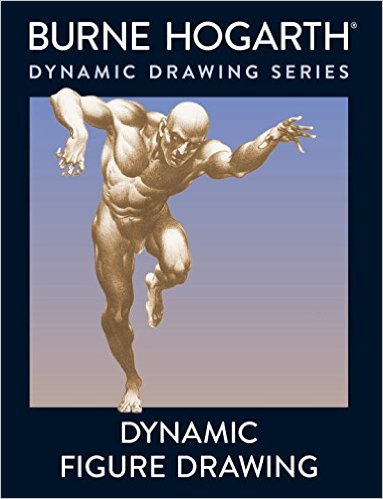
Dynamic Figure Drawing 

Burne Hogarth was one of the first anatomy books I had when I decided I wanted to be an artist back in my high school days. I can remember going to the bookstore and looking at Dynamic Figure Drawing over and over again, coveting it for the longest time before I had the money to buy it. Sadly I either lost or had to sell my copy around the time I was in college or so. But I never forgot looking at the cool dynamic figures with several sets of arms, legs, or heads drawn on a single pose to show the versatility of the pose and to show the human body in motion. This is not just a book of anatomy drawings, but a guide to how to draw the human figure in motion and with foreshortening.

How To Draw Manga: Illustrating Battles

Okay, okay, look, I know that a lot of the How To Draw Manga series is generally regarded as being “garbage”. The thing is though that many of them DO make good reference books. And the other thing is that this book is one of the few out there that actually goes into the theory of drawing all those cool, dynamic fight scenes that we all love in comics and manga. This is another book that I bought back in high school and lost when I was in college. (Maybe I had a book thief sneaking into my dorm at night or something? Or maybe I just loaned my beloved reference books out to the wrong people, who knows.) This book always stuck with me though in my mind because it doesn’t just have nice pictures in it to reference from. The text also describes the theory of why to draw the figures the way they show to illustrate motion. This book covers many topics of drawing battles, from different kinds of unarmed strikes and throws to fighting with weapons and also drawing battle damage on characters. (Doing research for this blog post, I found this book used on Amazon for less than $2 and I confess that I love it so much I bought it immediately to replace my long, long lost copy. I can’t wait for it to get here!)

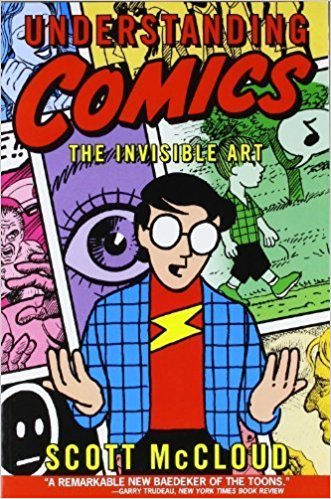
Understanding Comics and Making Comics 

The above header should read “anything by Scott McCloud” but I wanted to give links to actual books. If you’ve ever wanted to understand how and why comics work or don’t work, and the tactics of visual storytelling, Scott McCloud is the guy to read. Plus his books are presented as comics, so they’re easy to read and there’s lots of pictures. It’s a win-win!

Color Theory: An Essential Guide

This is a short book that is a great introduction to color theory. It introduces the concepts and theories without getting too bogged down in things and making color theory even more confusing than it can be. I still struggle with color theory because it’s such a vast topic with so many variables. But this book is a fantastic primer on the concepts for the beginning artist and I highly recommend it.

How To Make Webcomics

Okay, so How To Make Webcomics is a little outdated now as far as some of the topics go. There have been so many changes to technology and the convention scene since it came out that the age of this book really shows in spots. That being said, it’s also still a good reference on getting started in the practice and business of making webcomics. You just have to remember to take the advice in it with a grain of salt, because so much of the comics landscape has changed a lot since this book came out. It’s also geared more toward “gag-a-day” strips and so, as the creator of a long-form story comic I found a lot of the marketing type advice didn’t apply to me. It does have sections on writing, creating characters, prepping your comic images for posting, web-site design, site hosting, and interacting with your audience though, and those sorts of topics can be applicable to almost all comic creators no matter what your you’re creating your comics in.

So those are my personal recommendations for books for beginning artists. Have you read any of these books? Which books have you found helpful on your own art journey?

Posted on Leave a comment

My Mission and Philosophy

Writing a blog about my artistic mission and philosophy feels a lot like a college art assignment, but I’ll do my best. It feels a bit like writing an artist’s statement, actually!

So what can I say about my mission and philosophy of creating art? I feel like I am, at my deepest heart of hearts, a storyteller. Whether I’m writing a novel, or a blog, or a comic, I like to tell a story. And when I’m drawing, whether it’s sketching or illustrating or doing sequential art, I still like to tell a story. Even a drawing of one character can tell a story. I keep this in mind most of the time when I’m drawing something. Some of my art (especially warm-up sketches) are just character studies. But they can be so much more. I love when I can create an illustration or a sketch that tells a story about the character or the creature on the page.

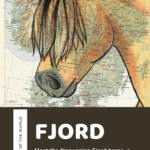
My Horses of the World series of drawings started off with this idea in mind. The vintage map pages that I use to draw on are beautiful, and nearly anything drawn on them would look wonderful. But the reason I choose the pages I do, and the reason I draw horses on them is first to tell a story. Each breed is drawn on the map page of the country where the breed originates from. An Arabian on Saudi Arabia, a Fjord horse on Norway, a Heihe on China. It can be easy here in the United States to see this different breeds and forget where they come from, both in the U.S. and in the world. We can see a Percheron or a Paso Fino and not really think about where that breed has come from, and what it means for a horse to be of that breed. So I hope these images make people think about the horses they love and the journeys they’ve made to come into our lives.

But even something like a quick character illustration or character design can tell a deeper story. For instance, one of my warmup sketches in early 2018, tells a story despite being fairly simple. The character in this sketch is from a novel series that I’ve been working on for a long time. I published the first back in 2009 and am currently working on the second book. The second book takes place two years after the first, so this character has aged a little bit but is still fairly young. In this sketch she is running late, as is obvious from her pose of running and her looking at her wrist to see the time on her watch.

But what else does the illustration tell us? I specifically put her in a school uniform so there is an idea of her age and that she attends a private high school. If I’d dressed her in her casual clothing it could have been more difficult to get a sense of her age, other than she’s obviously on the younger side. In different clothes and without the bow in her ponytail, she could be a young professional woman on her way to a meeting who’s just realized she’s about to miss her train. I gave her a messenger bag, but the bag is decorated with cute keychains and pins, another hint to her young age and to her cheerful personality.

These are the kinds of details that I think about when I try to tell a story with an illustration. Drawing images like this, that have a meaning and aren’t just a character standing around doing nothing, are my favorite types of images to draw!

One of the reasons I wanted to become an artist and writer and to tell stories in the first place is because of the stories I grew up with when I was a child. My parents read to us a lot when we were young. My brother and I were reading books at high reading levels from a young age. I’m the youngest of four children, and all three of my siblings are boys. I grew up as a bit of a tomboy (naturally, with three brothers!) in the 1980’s. My closest brother had bad asthma when we were young, and since he was my best friend we were inside much of the time. We played with toys, of course, but we also watched Saturday Morning Cartoons and such, especially after we got cable when I was a little bit older.

I remember watching shows like Teenage Mutant Ninja Turtles and GI Joe and Transformers and thinking “Where are the girls?!” Sure, April O’Neil was capable and competent in TMNT, but let’s face it, she was pretty much a damsel in distress most of the time. I never saw myself, a girl who was strong and capable, in any of the stories I watched as a child. I remember seeing Beauty and the Beast when it came out and nearly crying, because not only was there finally a Disney Princess who looked like me (brown hair, brown eyes), but who also was smart and strong. I didn’t want to play as a damsel in distress when my brothers and I played. I wanted to save the world just the same as the boys did! So when I began to write stories, I tried to include women and girls who saved the world and were just as capable as their male counterparts at being completely badass and heroic.

These two things, telling stories and inspiring young women to be strong, are the two things that are the most important to me in my art.